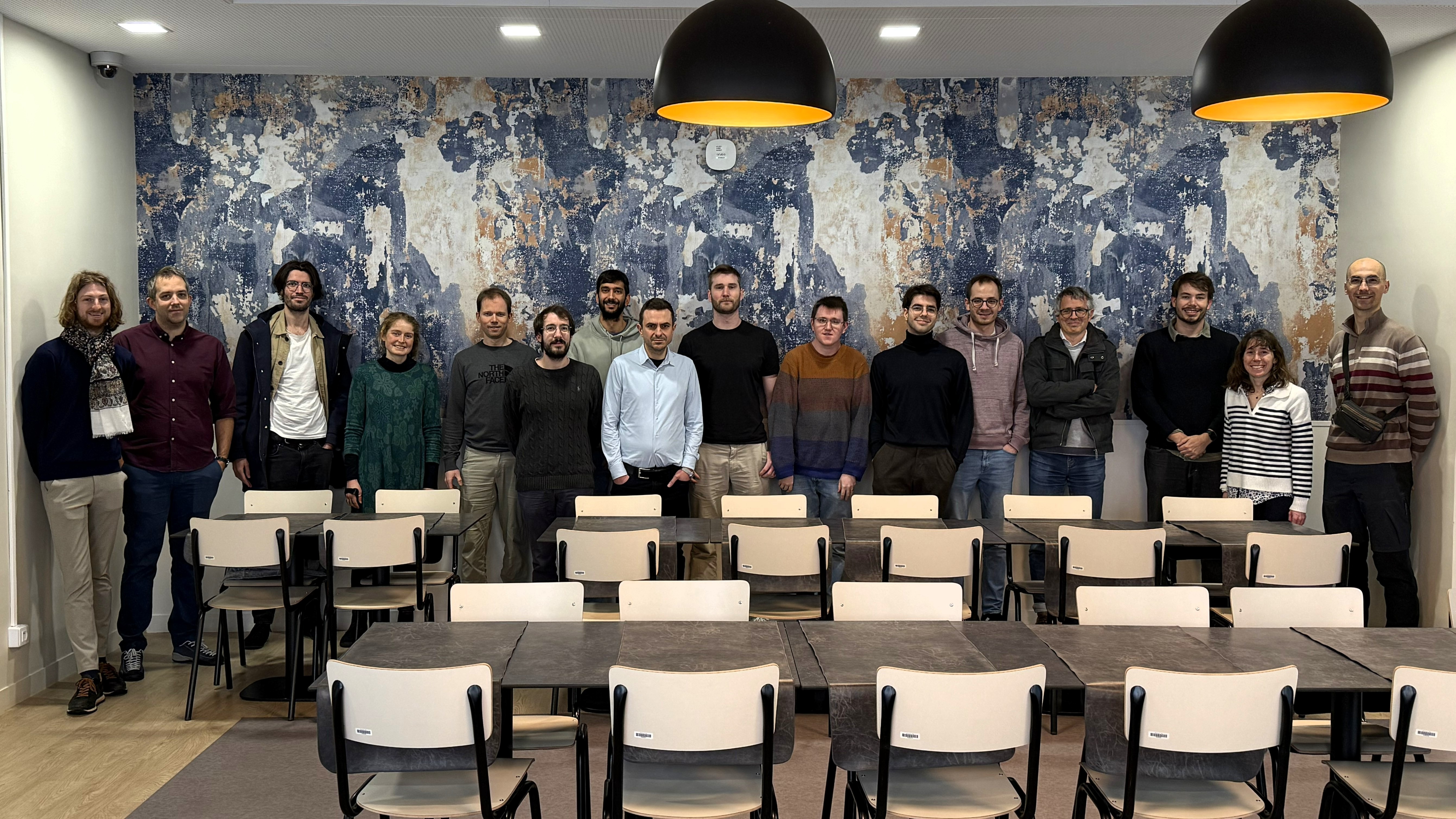
Annual Meeting for QuantERA Project TouQan in Lyon
Posted on Thu 12 February 2026
We had our second annual meeting of the TouQan project, which took place from February 9–12, 2026, at ENS Lyon. The meeting brought together our partners for research talks, external invited lectures, and project governance discussions. We would like to warmly thank our external speakers — Giacomo de Palma, Simone Rademacher, and Cécilia Lancien — for their excellent talks and fruitful discussions.
List of Participants
The following members of the collaboration attended:
- Instituto de Física Teórica CSIC - Madrid: Alvaro Alhambra, Matteo Scandi
- University of Tübingen: Tim Möbus
- Inria, École Normale Supérieure de Lyon, France: Mischa Woods, Samuel Slezak
- Center for Theoretical Physics PAS, Warsaw: Michał Oszmaniec, Oliver Reardon-Smith, Daiki Suruga
- Hamburg University of Technology, Germany: Martin Kliesch, Özgün Kum
- University of Copenhagen: Daniel Stilck França
Meeting Agenda
Our meeting agenda featured presentations from all partners as well as invited external speakers! In addition, we were glad to host two PhD defenses connected to our group: Victor Martinez and Emily Beatty.
Monday, February 9
- 10:00-12:00: PhD Defense: Victor Martinez
- 12:00-13:30: Lunch break
- 14:30-15:30: Presentation [P1] by Matteo Scandi
- 15:30-16:30: Presentation [P2] by Mischa Woods
Tuesday, February 10
- 09:30-10:00: Arrival and coffee
- 10:00-11:00: Presentation [P3] by Jan Kochanowski
- 11:00-12:00: Presentation [P4] by Özgün Kum
- 12:00-13:00: Lunch break
- 13:00-14:00: Presentation [P5] by Giacomo de Palma
- 14:00-18:00: Open discussions and research collaboration
Wednesday, February 11
- 09:30-10:00: Arrival and coffee
- 10:00-11:00: Presentation [P6] by Tim Möbus
- 11:00-12:00: Presentation [P7] by Samuel Slezak
- 12:00-13:00: Lunch break
- 13:00-14:00: Presentation [P8] by Oliver Reardon-Smith
- 14:00-16:00: Executive Meeting
- 19:00: Conference Dinner
Thursday, February 12
- 09:30-10:00: Arrival and coffee
- 10:00-11:00: Presentation [P9] by Simone Rademacher
- 11:00-12:00: Presentation [P10] by Cécilia Lancien
- 12:00-14:00: Lunch break
- 14:00-16:00: PhD Defense: Emily Beatty
Presentation titles and summary
- [P1] Matteo Scandi: (title TBA)
- [P2] Mischa Woods: (title TBA)
- [P3] Jan Kochanowski: "Hypercontractivity, Mixed Schatten Norms, Trace Contraction and their Computational Complexities".
We show that computing the trace contraction coefficient of a quantum channel is NP-hard, and establish related hardness results for mixed Schatten norms.
This quantity serves as a measure of how well a channel can be used to transmit a classical bit. Furthermore, we consider mixed Schatten norms and their completely bounded versions, and show that approximating the optimal ancilla-unassisted distinguishability of two entanglement-breaking channels, as well as the minimal Rényi output entropy of a quantum channel, are also NP-hard. We also present efficient approximation algorithms and highlight a motivating connection between hypercontractivity and mixing times of Markovian dynamics. - [P4] Özgün Kum: "Fermionic Hamiltonian Engineering with local operators".
We introduce a framework for fermionic Hamiltonian engineering by conjugating free evolution with sequences of local fermionic unitaries, obtained efficiently via a linear program.
By interleaving system evolution with these local unitaries, our method realizes effective time evolution under a broad class of target Hamiltonians with intrinsic robustness to implementation errors. In particular, we demonstrate that arbitrary complex tunnelling amplitudes can be realized, constrained only by the connectivity of the underlying system Hamiltonian. - [P5] Giacomo de Palma: "Efficient classical simulation of wide quantum neural networks".
We propose an efficient classical algorithm to estimate the Neural Tangent Kernel of a broad class of quantum neural networks built from Clifford and Pauli-group gates.
The algorithm replaces the average over initialization parameters with an average over just four discrete Clifford values, enabling efficient classical simulation. Combined with the equivalence between wide quantum neural networks and Gaussian processes, this shows that such networks cannot achieve quantum advantage. - [P6] Tim Möbus: "Bosonic Hamiltonian Learning with the Help of Moment Propagation Bounds".
We present a framework for efficient Hamiltonian learning of bosonic systems using coherent-state preparation, heterodyne detection, and engineered dissipation.
At the core lies a moment criterion based on the particle-number operator, which enables Lieb–Robinson-type bounds and extends learning techniques to bosonic m-mode Hamiltonians expressed as polynomials in creation and annihilation operators. We achieve both standard quantum limit and Heisenberg-limited scaling, enforced through photon-dissipation mechanisms inspired by the bosonic cat code. - [P7] Samuel Slezak: "Polynomial-time thermalization and Gibbs sampling from system-bath couplings".
We study Lindbladians approximating a system weakly coupled to a bath and prove polynomial-time convergence for high-temperature lattices, weakly interacting fermions, and 1D spin chains.
Our results demonstrate that simple dissipative quantum algorithms can prepare complex Gibbs states and that Lindblad dynamics accurately capture thermal relaxation. The proofs rely on a novel technical result that extrapolates spectral gap lower bounds from quasi-local to non-local Lindbladians. - [P8] Oliver Reardon-Smith: "Improved simulation of quantum circuits dominated by free fermionic operations".
We develop classical simulation algorithms for circuits built primarily from fermionic Gaussian gates, with runtime scaling in the number of non-Gaussian magic gates.
This extends the program of simulating circuits with small amounts of magic to the fermionic setting, complementing existing results for low-entanglement circuits and circuits with few non-Clifford gates. Adding extra non-Gaussian gates promotes these circuits to quantum universality, but circuits with few such gates remain tractable. - [P9] Simone Rademacher: "Tail bounds and large deviations for Bose-Einstein condensates".
We study the ground state of an interacting Bose gas on the three-dimensional unit torus and prove large deviation estimates in the mean-field and Gross-Pitaevskii regimes.
For weak interactions in the mean-field regime, we show that bounded one-particle operators satisfy large deviation estimates and compute the rate function up to second order. For singular interactions in the Gross-Pitaevskii regime, we prove tail bounds for the quantum depletion based on an explicit asymptotic formula for its generating function. - [P10] Cécilia Lancien: "(In)compatibility of random measurements".
We study the generic incompatibility of random quantum measurements, characterizing the typical noise needed to make them compatible across several random models.
We develop general techniques based on incompatibility witnesses and apply them to random measurements using tools from free probability and random matrix theory. Previous works focused on the maximum incompatibility for fixed parameters; we instead characterize the generic value.